Imagine sitting at your desk, staring at a long to-do list, and wondering why your business isn’t thriving as expected. As the founder of your company, the pressure to succeed is immense.
You have plans, ideas, and a burning desire to make it happen, but there’s a glaring gap – your business model.
Let’s delve into what a business model really is and why it’s crucial for your success in entrepreneurship and your approach to business.

Understanding the Fundamentals of a Business Model
In the world of entrepreneurship, a solid understanding of a business model is paramount.
But what exactly is a business model?
In simple terms, it’s a company’s plan for making a profit.
It answers the crucial question: What’s your plan for profit? This concept encompasses various elements, including products, target market, and expenses. Each component plays a vital role in ensuring that a business not only survives but thrives.
Definition of a Business Model

A business model outlines how a company intends to deliver value to its customers while generating revenue. According to Investopedia, a business model is essentially a blueprint for making money. However, this definition can feel abstract. In fact, entrepreneurs should be able to define their business model in a single sentence.
This exercise prompts reflection on how they plan to achieve profitability.
A business model must include:
- Products or Services: What are you offering?
- Target Market: Who are your customers?
- Expenses: What are your costs?
By breaking it down, entrepreneurs can better understand their approach to the market.
Identifying Key Components

Each element of a business model is interconnected. For instance, the products or services a company offers should resonate with its target market.
If there’s a mismatch, profitability can suffer.
When you’re thinking through your business model, it’s not just about numbers and offerings—it’s about how everything connects.
That’s where the 3Ps + You Framework comes in.
This approach helps you look at your business model from four essential angles:
- People: Who’s supporting your work (team, contractors, clients) and how those relationships affect your energy and output
- Products/Services: What you’re offering, how it’s priced, and whether it aligns with the results you actually want to deliver
- Processes: The systems that hold it all together—from onboarding and delivery to decision-making and delegation
- You: The often-overlooked piece—your mindset, capacity, and clarity as the leader behind it all
If any one of these areas is out of sync, your business model will start to feel heavier than it should. But when all four are aligned, that’s when things click. You get clarity. Your offers land. Your team knows what to do. You start to feel like your business actually fits you again.
That’s what a strong business model should do—not just make money, but make sense for the way you want to work and live.
When considering products and services, entrepreneurs should ask themselves two main questions:
- Do my offerings provide sufficient value?
- Are they transformative experiences for my customers?
Moreover, pricing does play a significant role.
If the perceived value does not match the price, customers may look elsewhere. Thus, understanding customer demand is also crucial.
The Missteps of Neglecting a Cohesive Business Model

Neglecting a cohesive business model can lead to significant pitfalls. Even the best systems and processes will fail without a solid foundation. A flawed business model can create confusion and inefficiencies. This can result in wasted resources and lost opportunities.
Consider the following missteps:
- Lack of Clarity: Without a clear understanding of the business model, teams may struggle to align their efforts.
- Ignoring the Target Market: Failing to identify and understand the target audience can lead to misguided marketing strategies.
- Underestimating Expenses: Not accounting for all costs can result in financial strain.
For a successful business, entrepreneurs should regularly revisit their business model. As businesses grow and evolve, so too must their strategies. This adaptability is key to sustaining success.
Understanding the fundamentals of a business model is essential for any entrepreneur.
By defining their approach to profitability, identifying key components, and avoiding common missteps, they can set themselves up for long-term success. While distilling the business model into one or two simple sentences can provide clarity and direction.
After all, a clear business premise is the first step toward effective execution.
Why Simplicity and Alignment Matter
You don’t need a 20-page business plan to have a solid business model.
You need clarity. Simplicity. Alignment.
When your offers, audience, expenses, and systems are all pulling in different directions, it’s no wonder progress feels slow. But when they all work together—when your pricing makes sense for your goals, your clients are clear on what they’re getting, and your operations support the experience you promise—that’s when your business starts to feel lighter.
More easeful. More like you.
This is why I believe your business model shouldn’t just make money.
It should make sense for the way you want to live and lead.
A Simple Way to Define Your Business Model
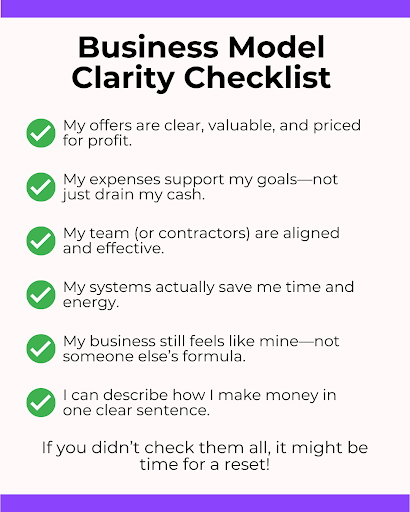
So, here’s a challenge: try to define your business model in one sentence.
Not a tagline. Not your mission. A one-liner that explains how your business generates profit in a way that feels aligned.
Something like:
“I provide systems strategy intensives for overwhelmed service providers so they can run more efficiently and scale without burnout.”
or
“We offer community-based coaching for creative entrepreneurs who want to grow without losing their voice or values.”
The goal isn’t perfection. We want clarity. When you can say it simply, you can build it intentionally.
Ready to Rework Your Business Model?

If reading this made you realize your model could use a refresh—you’re not alone.
Many business owners don’t stop to rework the foundation until things feel messy, misaligned, or harder than they should. The good news? It’s never too late to shift. Whether you need to simplify your offers, rethink your expenses, or revisit your pricing, now is the perfect time to check in.
Start with one simple question:
Is my current model still working for who I am and what I want now?
And if not—what needs to change?
Because clarity in your business model isn’t just about growth. It’s about building something that’s truly yours. Something that works—and works for you.
Want help assessing your business model or mapping out your next phase? A VIP Day Intensive might be the reset you need.